During my studies of what it means to be forgotten space, (The space between known spaces, left to time) I came across the vast community of practitioners and theorists, including Ignasi de Solà-Morales, Gilles Clement, Henri Lefebvre, Krystallia Kamasinou, Michael Foucault, and Jasim Azhar, amongst others. Whilst all research speaks positively about the potential of spaces, the definitions and language surrounding space are highly contested and ever-shifting, leaving what appears to be a critical gap in spatial knowledge for understanding what such spaces are.
Variance in Definition
French philosopher Michel Foucault proposes that these spaces operate on the fringes of society(1), serving as spaces of ‘other’, whether physical or social. Alternatively, in a more spatial manner, these heterotopias are described as “opening, pure, and simple, but once inside you become aware you have in fact gone nowhere.”(2) Describing a room anyone can enter and dwell, but in no way enter into the house itself, similar to an apartment lobby. This kind of spatial limbo is neither inside the privacy of the home nor completely outside in the public realm.
French Landscape Architect Gilles Clement describes these spaces as ‘third landscapes’(3) and notes that all development creates neglected spaces, and within the context of landscape architecture, given long periods of time, develops heterogeneous and chaotic landscapes of biodiversity when left undisturbed.(4) From that, could it also be assumed that in the same manner that nature forms diverse landscapes, could human-led diversity of action form within such a space too, as discussed by Kenneth Bromphy in his analysis of ever-changing remote henges in Glasgow. (5)
Ignasi de Solà-Morales, in a faint but present connection with Gilles Clement, and Kenneth Bromphy, considers in his book ‘Terrain Vague’ that argues that terrain vague sits between the organic and the inorganic,(6) overlapping with the ideas of third landscapes proposed by Gilles Clement, but instead of a space’s potential for biodiversity, Ignasi de Solà-Morales focuses on the potentiality of space for social activity and interpretation, similar to that of Kenneth. A critique of this would be the spatial characteristics, work within the context of urban fringes where built environments meet natural landscapes, however, to question what this looks like in a dense urban environment is something of a mystery.
Agata Pluta offers a description of space that differs to the spatial descriptions of the theorists discussed above. Agata Pulta describes ‘forgotten spaces’(7) as spaces that are not physically situated between spaces, instead focusing on a space’s mental relevancy when rendered within memories of the urban environment. The paper states that “urban voids can be unused, not solely because of their limited functionality, but also due to the fact that people do not notice them at all. These places are not separated by physical walls, not prohibited – they are inaccessible because of their invisibility.”(8) This description at the time of writing is one that resonates most with the irregularity and shifting nature of spaces within such dense urban environments.
Krystallia Kamasinou, similarly to Ignasi de Solà-Morales, while not specifically labelling space, describes these spaces as “spaces for conditions of zero”(9) in the sense that they are free from reason, conformity and rationale, enabling one to treat the space as a blank canvas for creativity and self-expression.
Jasim Azhar et al. Identifies the gap in knowledge within the theoretical profession: an understanding of the potential of such spaces; however, methods of achieving that potential remain fragmented.(10) Additionally, various, sometimes conflicting methods of identification are proposed to address the conceptual ambiguity of space across various scales.(11) The proposed method separates spatial scales into macro and micro, with definitions of space based on use and physical associations of ‘urban leftover space’ within its context. This seemingly rigid description, whilst perhaps true in particular contexts, does not fit within the context of a dense urban environment where the physical properties of what could be thought of as forgotten space vary greatly.
Proposition of Definition, Forgotten Spaces
Taking into account the various overlapping definitions of space and method of identification, subjectively, the term of “forgotten space”(12), as proposed by Agata Pulta, fits quite well within the contexts of the spaces being observed within Sydney CBD. As the term is not based in spatial rules. Rather these forgotten spaces sit outside public observation and memory(13), their aesthetics (often shaded, minimal lighting, occasional smell), lack of socialble amenities, and utilitarian functionality confine their use to servicing the surrounding buildings during business hours, leaving one with no reason or will to explore them further.

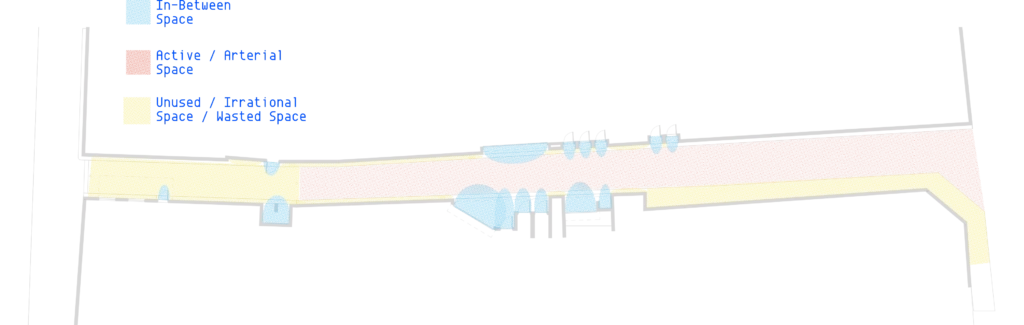
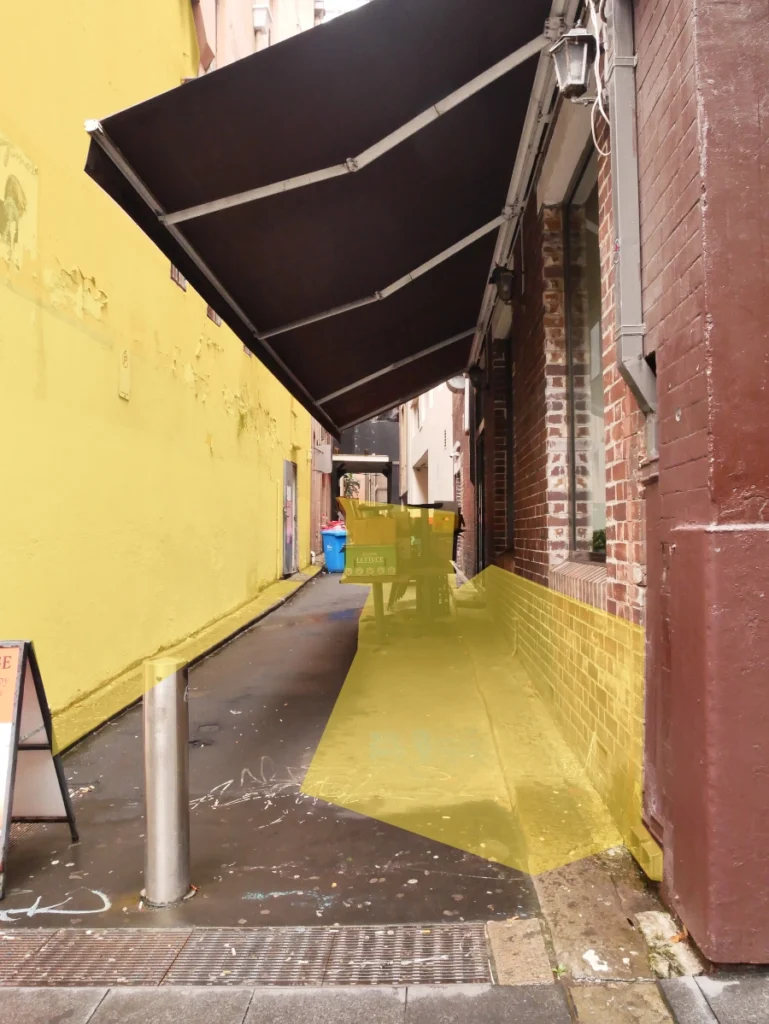
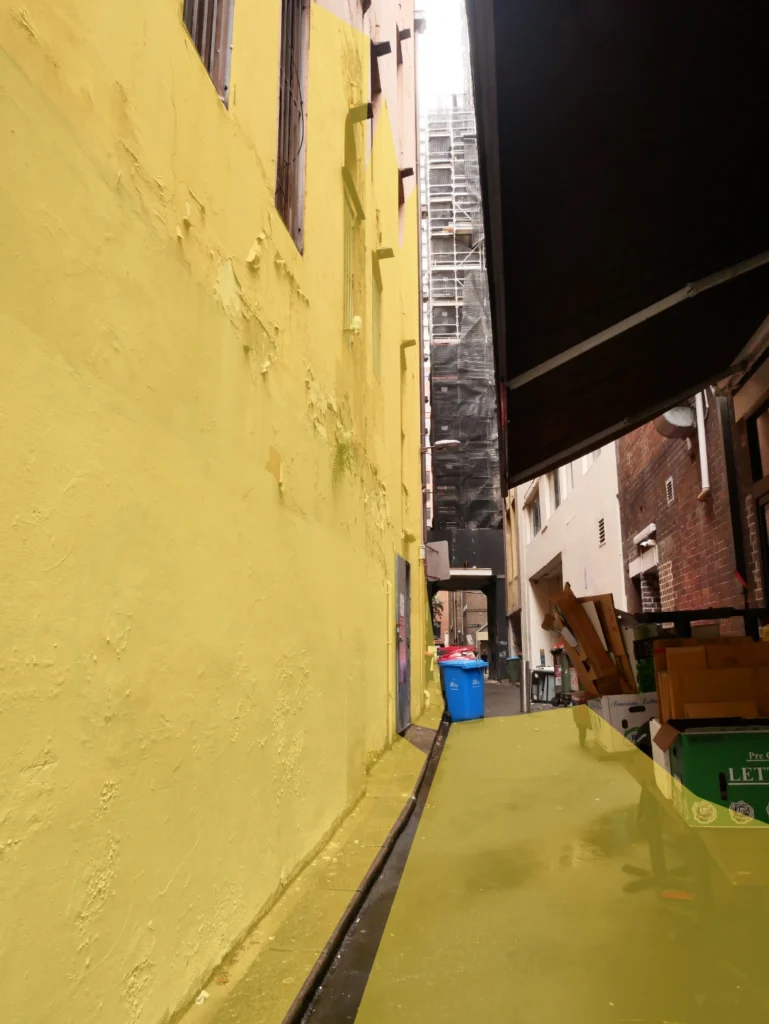
In conjunction with the umbrella term, forgotten spaces, the macro and micro scales discussed by Jasim Azhar et al.(14), when in the context of the city, are an interesting method of breaking down spaces which I will incorporate and hopefully expand upon, in a useful manner here. While on a macro scale, the spaces are forgotten, situated within the zone, beyond public memory; understood solely by those who work in and around them. Within such forgotten spaces, on a micro level, voids exist between elements and spaces (active and semi-active) within these forgotten spaces. Actively used spaces, as can be seen highlighted in yellow across the images taken within said alleys. It is within these spaces that fertile ground for the exploration of intervention is found, as they sit physically independent of context, yet close enough to maintain spatial relationships that one can explore and expand upon. This definition of space provides the fundamental framework for the further exploration of possible interventions within the sites.